Detailed registry entries for formally recognised and emerging HLTI listings.
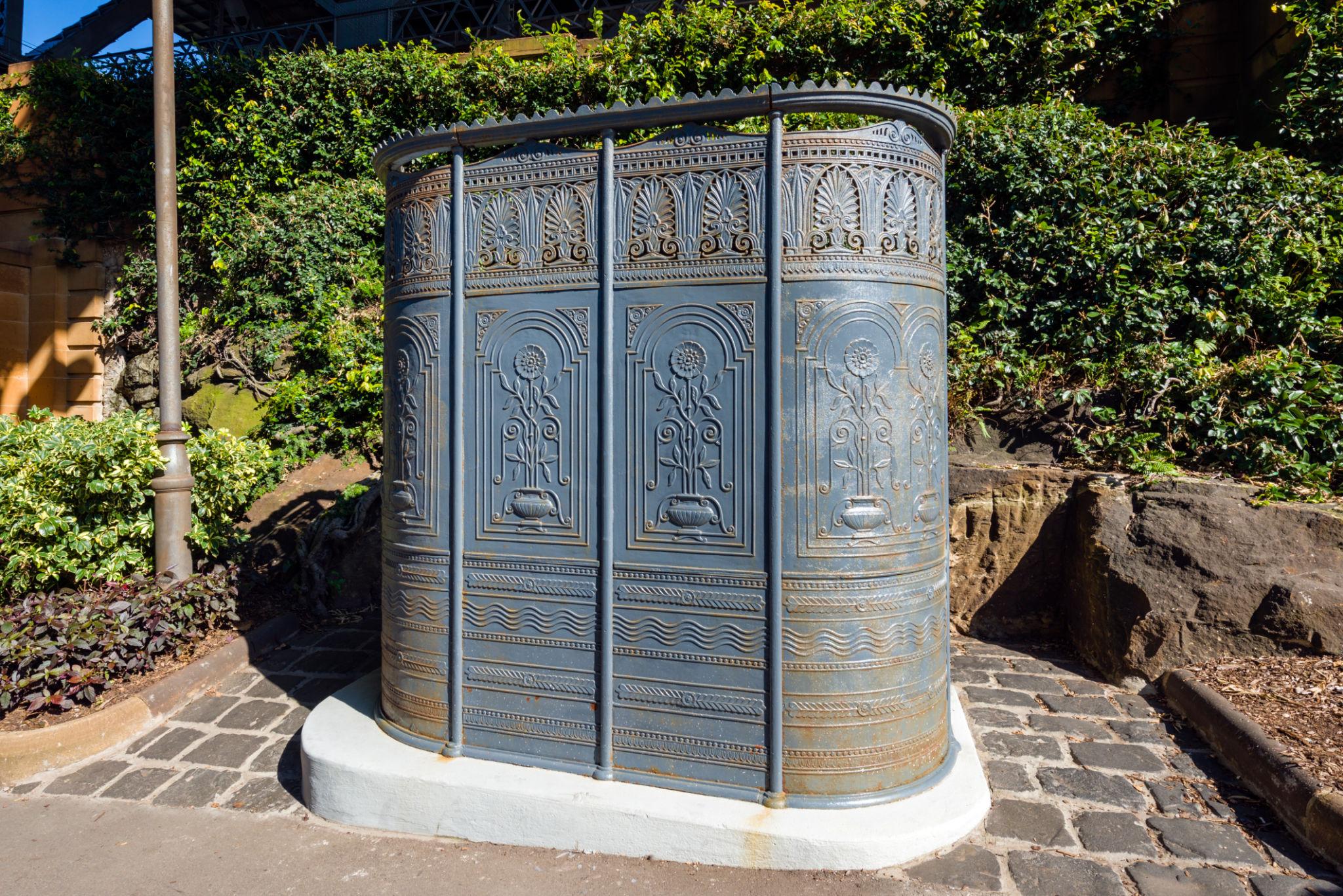
Photographic record: George Street Pissoir, Dawes Point NSW
Statement of Significance
The George Street Pissoir is recognised for its enduring contribution to public sanitation infrastructure and its rare survival as an early 20th-century open-air urinal.
Installed during a period of rapid urban growth and public health reform, the site reflects a time when civic design prioritised functional accessibility for male users within a constrained social framework.
Its continued presence—largely unchanged—offers a direct, unmediated insight into historical approaches to amenity provision, discretion, and urban form.
Architectural & Design Features
- Prefabricated cast iron structure, imported and assembled on site
- Ornate panel work combining utility with civic ornamentation
- Open-air configuration with partial visual shielding
- Circular/segmented layout enabling multi-user functionality
- Durable materiality demonstrating long-term resistance to environmental exposure
The structure presents a notable contrast between decorative intent and utilitarian purpose, uncommon in contemporary amenity design.
Operational Characteristics
- Designed for continuous access, with no formal entry/exit control
- Supports rapid throughput under transient usage patterns
- Minimal reliance on mechanical systems
- Highly resilient to fluctuating demand and environmental conditions
The site operates effectively as a low-complexity, high-availability system.
Behavioural & Cultural Observations
- Facilitates brief, transactional use with minimal dwell time
- Encourages implicit behavioural norms relating to spacing, orientation and discretion
- Reflects historical exclusion of female users from equivalent public infrastructure
- Demonstrates how design constrains and directs human behaviour without instruction
The site provides a clear example of environment shaping behaviour under unspoken social rules.
Listing Rationale
The George Street Pissoir meets multiple HLTI criteria, particularly in relation to authenticity, cultural continuity and behavioural influence.
Its preservation enables ongoing public interaction with a form of infrastructure that has largely disappeared from the urban landscape, while continuing to perform its original function with minimal adaptation.
Notable Considerations
- Represents a gender-specific approach to public amenity provision
- Highlights early integration of sanitation infrastructure into dense urban environments
- Serves as a benchmark for evaluating subsequent shifts toward enclosed, inclusive and technologically supported facilities
HLTI Positioning
This site is considered a benchmark entry within the HLTI register, establishing foundational criteria for the identification and assessment of culturally significant public conveniences across Australia.
HLTI Assessment Summary
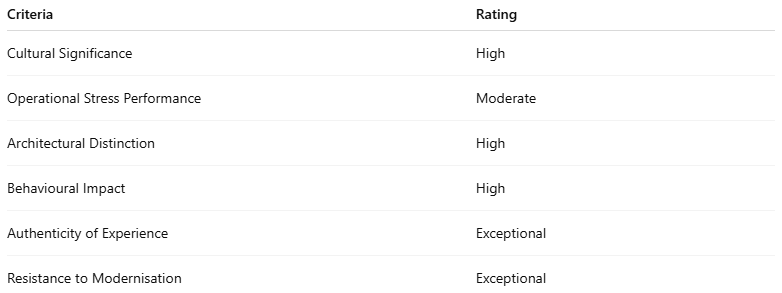
HLTI assessment matrix: George Street Pissoir
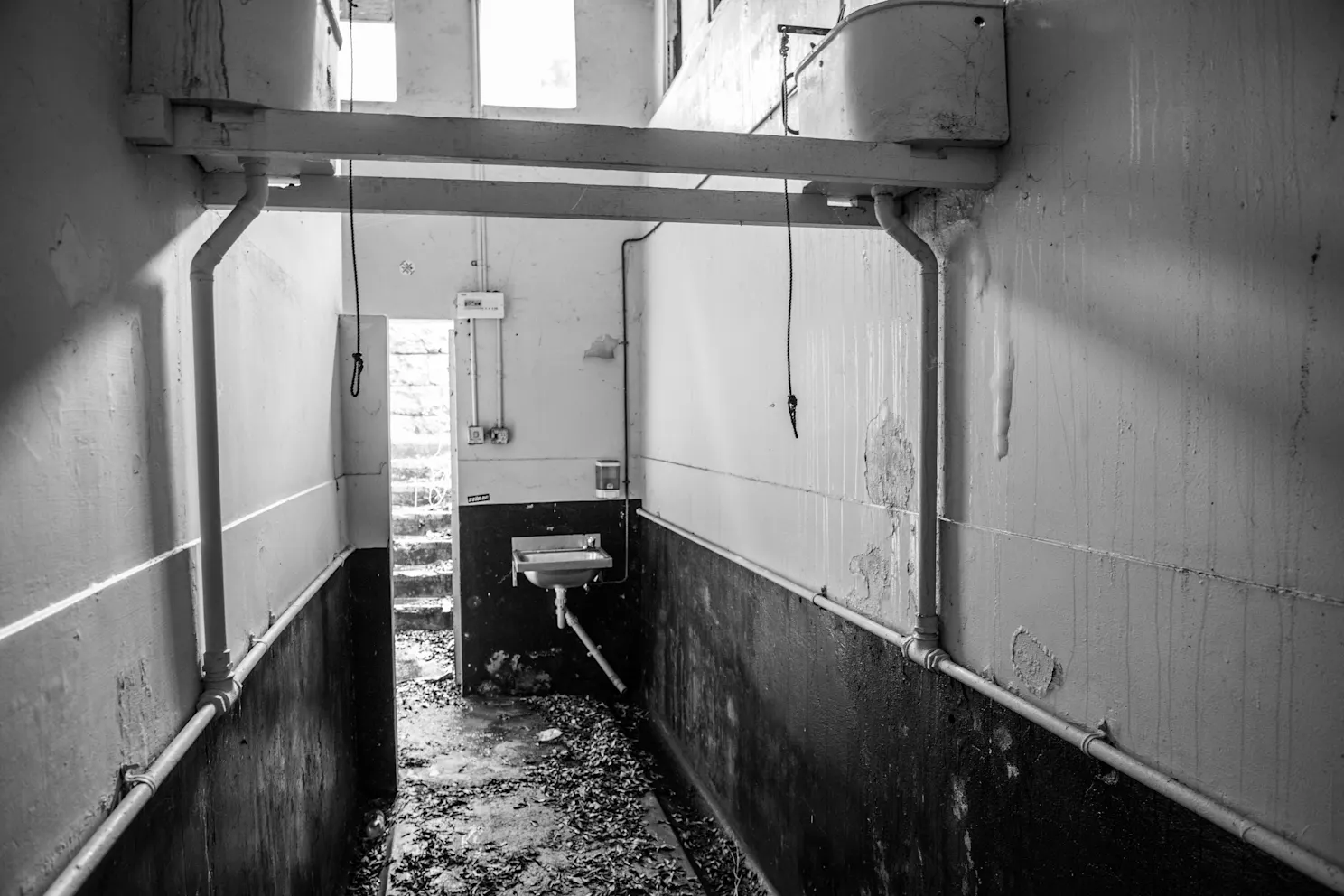
Photographic record: Leichhardt Oval amenities precinct
Statement of Significance
The amenities located beneath the Robinson Stand at Leichhardt Oval are recognised for their emerging cultural significance within Australian rugby league environments.
While not formally heritage-listed, the site demonstrates a sustained role in supporting high-density, emotionally charged crowd conditions, particularly during peak match-day intervals.
Its significance is derived not from formal architectural merit, but from its contribution to shared supporter experience, behavioural adaptation and collective memory.
Architectural & Design Features
- Substructure placement beneath a legacy grandstand
- Predominantly raw concrete construction with exposed service infrastructure
- Low-ceiling environments contributing to spatial compression
- Linear access points with limited expansion capacity
- Functional layout prioritising throughput over comfort
The design reflects a period where capacity and durability were prioritised over user experience, resulting in an environment that remains largely unchanged in its core configuration.
Operational Characteristics
- Subject to extreme peak demand events, particularly during halftime
- Queue formation extends beyond designated areas, often integrating with pedestrian flow
- Limited visibility of internal conditions from external vantage points
- Environmental factors including heat, congestion and noise influence operational performance
The site operates as a stress-tested system, with performance defined less by efficiency and more by user tolerance and adaptive behaviour.
Behavioural & Cultural Observations
- Users exhibit rapid decision-making under time pressure, balancing queue length against urgency
- Informal systems emerge, including queue negotiation, spatial optimisation and acceptance of reduced personal boundaries
- Shared experience contributes to collective identity formation among attendees
- The site functions as an unspoken but understood component of the “Leichhardt Oval experience”
The environment provides a clear case study in human behaviour under constrained conditions, where design limitations directly shape interaction patterns.
Listing Rationale
The Robinson Stand amenities at Leichhardt Oval meet key HLTI criteria relating to operational stress performance, behavioural impact and authenticity of experience.
Despite the absence of formal heritage recognition, the site demonstrates enduring cultural relevance through its consistent role in shaping match-day dynamics and supporter narratives.
Notable Considerations
- Represents a non-curated, lived infrastructure experience within a major sporting venue
- Highlights the divergence between designed capacity and actual demand conditions
- Provides insight into how legacy infrastructure continues to function within modern expectations
HLTI Positioning
This site is classified as Emerging Significance, reflecting strong cultural and behavioural relevance with potential for future formal recognition.
It is considered a benchmark example of stadium-based amenities operating under sustained real-world pressure conditions, and serves as a comparative reference for similar sites across Australia.
HLTI Assessment Summary
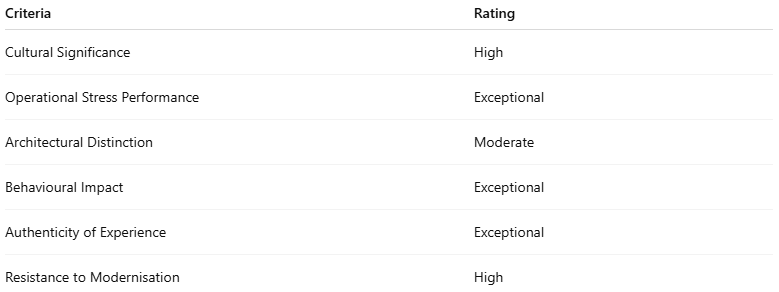
HLTI assessment matrix: Leichhardt Oval amenities precinct

Supporting evidence: unofficial commemorative marker
Kalyn Ponga–Kurt Mann Memorial Toilet
Provisional Designation
Statement of Significance
The Kalyn Ponga–Kurt Mann Memorial Toilet is recognised for its emerging cultural significance within contemporary rugby league environments.
The site is associated with a widely referenced match-day incident in which two senior players were observed utilising the facility concurrently during active play, generating sustained commentary and contributing to its informal designation.
Since this time, the site has been embedded within supporter narratives as a point of reference for unplanned system use under atypical conditions.
Architectural & Design Features
- Conventional stadium-adjacent configuration
- Functional layout with standardised fixtures and finishes
- Limited distinguishing architectural characteristics
- Designed for intermittent, high-volume use
The site’s significance is not derived from physical attributes, but from contextual association and subsequent cultural interpretation.
Operational Characteristics
- Typically subject to moderate demand, with periodic peak surges
- Standard queue formation patterns observed under normal conditions
- No documented structural or mechanical anomalies
However, the site has demonstrated capacity to support unscheduled use outside intended operational windows, indicating a degree of functional flexibility.
Behavioural & Cultural Observations
The associated incident has led to:
- Increased awareness of amenity location during live play
- Informal discussion regarding priority, timing and necessity
The site highlights the tension between professional obligation and physiological requirement.
It demonstrates that even at elite levels, systems are occasionally bypassed in favour of immediate need.
The site provides a notable example of human factors overriding structured environments, reinforcing the unpredictability inherent in real-world conditions.
Listing Rationale
The site meets HLTI criteria primarily through cultural association and behavioural insight, rather than architectural or operational distinction.
Its significance lies in its role as a reference point for discussions relating to decision-making under pressure, system boundaries and the realities of human need within structured environments.
Notable Considerations
- Classification as a “memorial” remains informal
- Location details are not formally verified within the register
- Ongoing relevance is dependent on continued reference within rugby league discourse
HLTI Positioning
This site is classified as Emerging Significance, reflecting its growing presence within contemporary sporting narratives.
It represents a modern category of HLTI site, where cultural relevance is derived not from age or design, but from incident-driven recognition and collective interpretation.
HLTI Assessment Summary
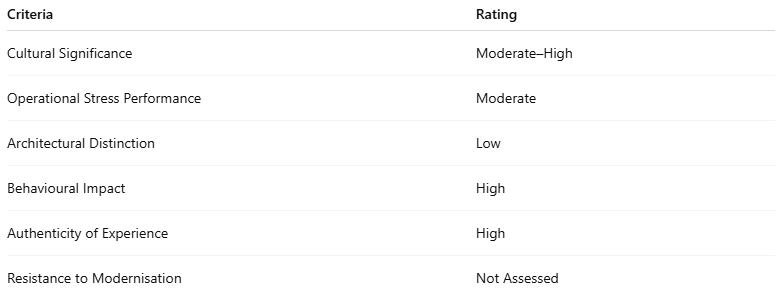
HLTI assessment matrix: Kalyn Ponga–Kurt Mann Memorial Toilet
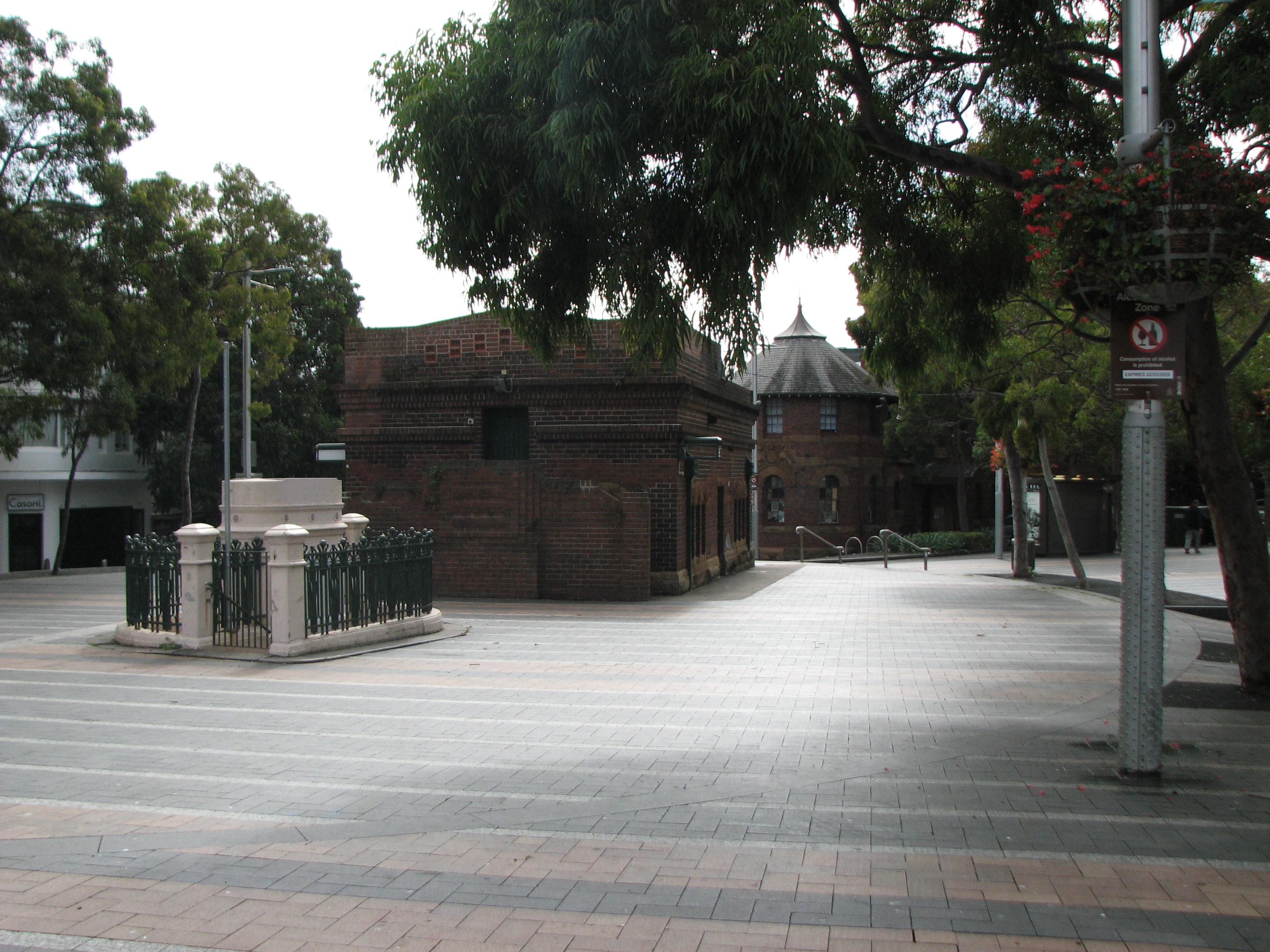
Photographic record: Taylor Square Underground Conveniences, Darlinghurst NSW
Taylor Square Substation No. 6 and Underground Conveniences
Statement of Significance
The Taylor Square Underground Conveniences are recognised for their
historical and operational significance as one of Sydney’s earliest
surviving underground public amenity systems.
Constructed during a period of expanding urban density and public
sanitation reform, the site reflects evolving approaches to the management
of visibility, behaviour and movement within the public realm.
Its subterranean configuration demonstrates an early civic preference for
maintaining amenity access while reducing the visual presence of associated
activity at street level.
Architectural & Design Features
- Underground configuration accessed via street-level stair entries
- Federation-era civic infrastructure integrated with surrounding streetscape
- Tiled internal surfaces designed for durability and maintenance efficiency
- Segregated circulation and constrained spatial geometry
- Substantial use of concrete and masonry construction
The site demonstrates a strong relationship between urban planning,
behavioural control and concealed infrastructure design.
Operational Characteristics
- Designed to support continuous public access within a high-density urban environment
- Separation from street level contributes to reduced visibility and environmental containment
- Constrained access geometry influences flow during elevated usage periods
- Acoustic amplification observed under moderate occupancy conditions
Despite its age, the site continues to demonstrate operational resilience
under varying conditions of use.
Behavioural & Cultural Observations
- Transition from street level to subterranean environment produces an immediate shift in user behaviour and pace
- Spatial compression encourages abbreviated interaction and reduced dwell time
- The concealed nature of the site contributes to heightened situational awareness and accelerated decision-making
- Informal negotiation of shared space is commonly observed during moderate occupancy
The site provides a notable example of how environmental transition alters
behavioural response, particularly within enclosed public systems.
Listing Rationale
The Taylor Square Underground Conveniences meet multiple HLTI criteria
relating to historical continuity, behavioural influence and authenticity
of experience.
The site remains a rare surviving example of an early underground public
amenity system and continues to provide insight into historical approaches
to urban sanitation infrastructure.
Notable Considerations
- Reflects early 20th-century attitudes toward visibility and public behaviour
- Demonstrates how civic infrastructure was integrated beneath active urban environments
- Retains significant original character despite evolving surrounding conditions
HLTI Positioning
This site is considered a foundational example of concealed urban amenity
infrastructure within the HLTI register.
It establishes a significant benchmark for understanding the relationship
between public access, behavioural management and environmental design
within dense civic environments.
HLTI Assessment Summary
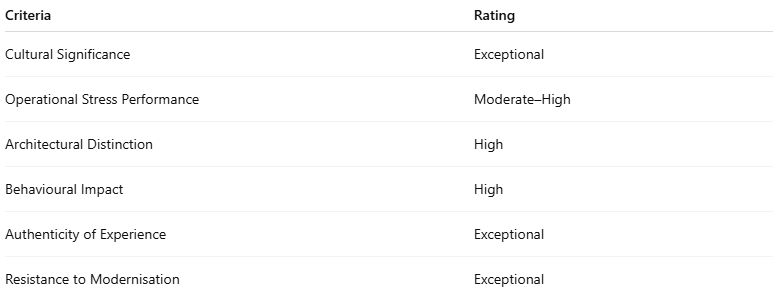
HLTI assessment matrix: Taylor Square Underground Conveniences
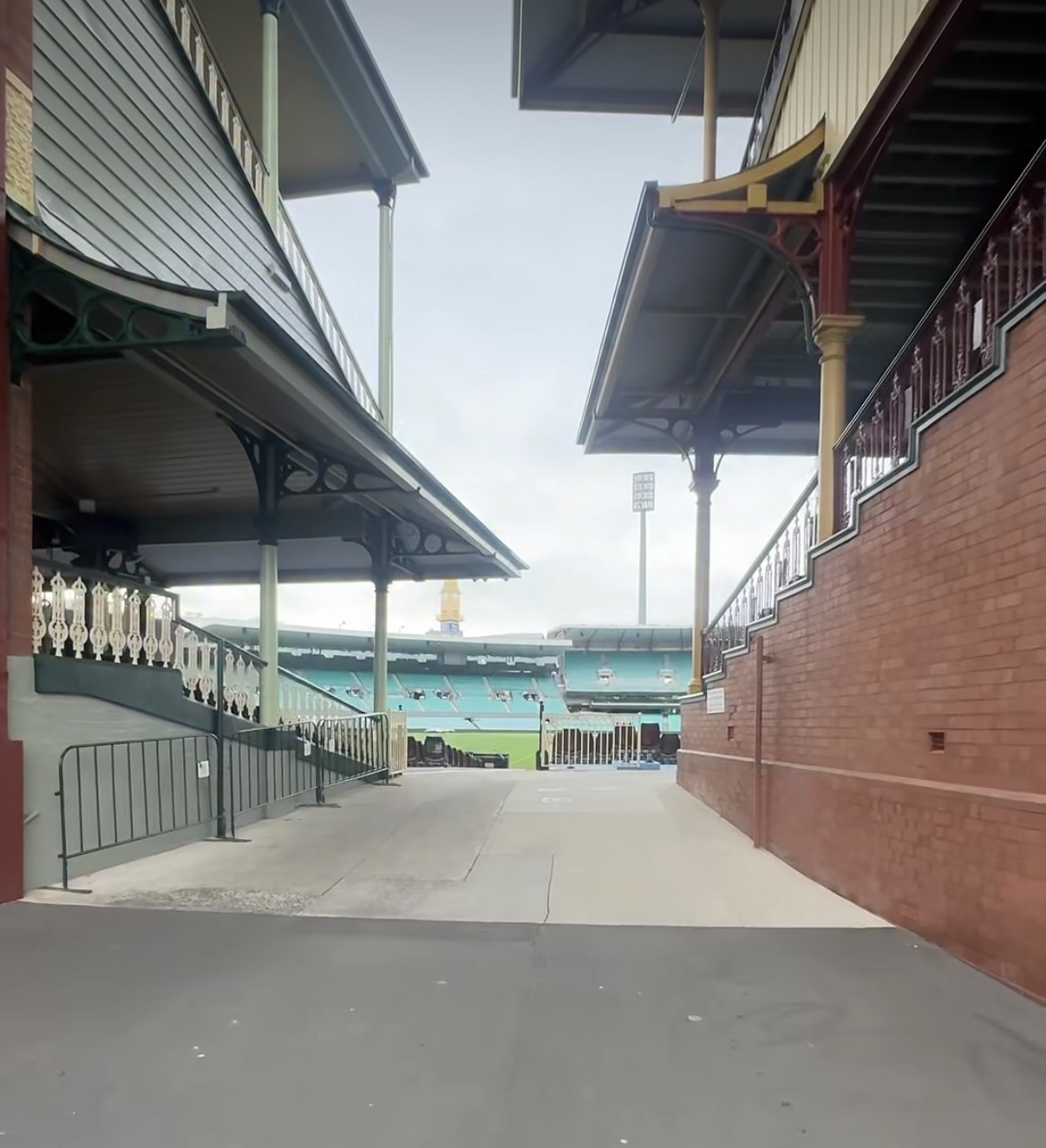
Photographic record: Sydney Cricket Ground legacy amenities network
Statement of Significance
The amenity systems integrated throughout the Sydney Cricket Ground (SCG)
are recognised for their enduring contribution to the operation and cultural
identity of one of Australia’s most established sporting venues.
Developed progressively across multiple eras of construction, the site
reflects changing approaches to crowd management, circulation and public
amenity provision within high-capacity sporting environments.
Unlike standalone facilities, the SCG amenities operate as part of a broader
behavioural ecosystem shaped by:
- session intervals
- atmospheric conditions
- crowd density
- and generational ritual
Architectural & Design Features
- Distributed amenities integrated beneath and within legacy grandstands
- Combination of exposed concrete infrastructure, tiled surfaces and progressively modernised service areas
- Variable ceiling heights and circulation widths reflecting differing construction eras
- Transition zones between open concourse environments and enclosed amenity spaces
The site demonstrates a layered architectural approach in which contemporary
interventions coexist alongside enduring legacy infrastructure.
Operational Characteristics
- Subject to sustained high-volume use across cricket, rugby league, AFL and major events
- Demand fluctuates according to session breaks, weather conditions and match intensity
- Peak load events generate queue compression, directional congestion and informal flow adaptation
The operational complexity of the SCG amenities is amplified by the venue’s
scale and multi-generational infrastructure network.
Behavioural & Cultural Observations
- Users demonstrate strong ritualised movement patterns associated with innings breaks, halftime intervals and beverage acquisition cycles
- Familiar attendees exhibit anticipatory positioning, route optimisation and venue-specific navigation behaviour
- Informal systems consistently emerge under pressure, particularly within legacy stand environments
The SCG provides a notable example of how long-standing sporting venues
develop embedded behavioural cultures extending beyond the field of play.
Listing Rationale
The SCG amenities meet multiple HLTI criteria relating to cultural continuity,
operational resilience and behavioural significance.
The site demonstrates how public amenities within major sporting venues
contribute not only to functional operation, but to the broader lived
experience and ritual structure associated with attendance.
Notable Considerations
- Amenity usage patterns vary significantly between sporting codes and event types
- Legacy infrastructure continues to shape contemporary crowd behaviour
- Environmental conditions, particularly heat and humidity, materially influence system performance during cricket events
HLTI Positioning
The SCG is recognised as a benchmark example of a large-scale, evolving
public amenity network operating within a nationally significant sporting
environment.
The site demonstrates the interaction between:
- legacy infrastructure
- crowd ritual
- and behavioural adaptation under sustained event conditions
HLTI Assessment Summary
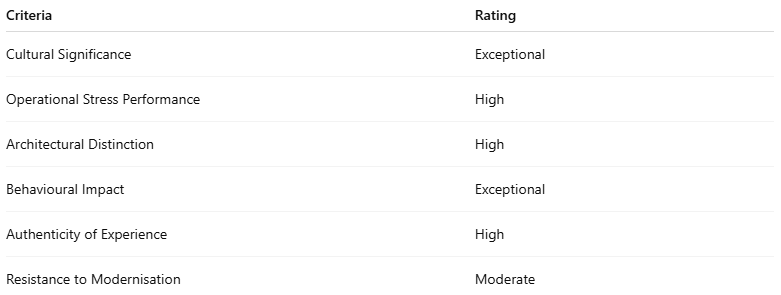
HLTI assessment matrix: Sydney Cricket Ground amenities network